
Product Packaging and Transportation | ACER ESG

Product Packaging and Transportation
Product Packaging and Forest Conservation Policy
We released our “Sustainable Paper and Packaging Policy” in 2012 in order to enhance the sustainability of global forest ecosystems, and in 2022, it evolved to become Acer Group’s “Product Packaging and Forest Conservation Policy”. Acer understands that deforestation will seriously impact the stability of the forest ecosystem, and we recognize and appreciate the efforts taken with our suppliers and partners to conserve forest ecosystems. Acer prohibits all business relationships with suppliers that are involved in deforestation and illegal logging. We only permit the sourcing of supplies from non-controversial sources and responsibly managed forests. In collaboration with relevant stakeholders, Acer strives to achieve the goal of no gross deforestation by committing to halt or reduce all deforestation associated with the production, trade, or sale of commodities, thereby promoting forest conservation.
Acer incorporates the below principles to strengthen the responsibility of our products and global operations. We also encourage our suppliers and partners to adopt the same principles to promote the conservation effects of the whole value chain:
- Ensure that businesses of the entire group comply with international, national and local forest conservation related regulations, that raw materials are obtained legally, and that suppliers do not violate forest conservation laws or be involved in illegal practices in the countries and regions where they conduct business.Maximize the use of eco-friendly paper in all operations, including those sourced from suppliers certified by the Forest Stewardship Council (FSC), the Programme for the Endorsement of Forest Certification (PEFC), or other forest-friendly paper sources, as well as recycled paper materials and eco-friendly ink printing. This approach aims to reduce environmental impact from a life cycle perspective and minimize the demand for deforestation.
- Work with suppliers and/or partners to increase materials efficiency of product packaging and minimize the consumption of paper products containing virgin pulp to reduce the harvesting of raw materials.
Collaborate with external partners involved in forest protection, such as non-profit organizations and academic institutions, to seek opportunities for forest conservation and restoration, jointly working toward the long-term goal of no deforestation.
The policy is reviewed, approved, and supervised by Acer's Board of Directors.
Use of environmentally friendly materials with streamlined design
Based on supplier information, Acer estimates that in 2024, a total of 12,831 tonnes of paper packaging materials (including cartons and paper cushion materials) were used in notebooks, desktop computers, and monitors.
Acer's packaging design principle begins with considering the life cycle of product packaging materials. Our aim is to continuously improve the environmental impact at every stage, from R&D and material selection, manufacturing, transportation, use to waste management. Through our green packaging policy, we strive to simplify packaging, standardize packaging dimensions, and gradually reduce the use of plastic packaging or replace it with recycled plastic to reduce packaging volume and weight to reduce energy and resources consumption in transportation stage. Additionally, we are constantly exploring ways to reuse or recycle packaging materials after removing the protective packaging of products, maximizing their utility and extending their life cycle.

Notebook computers
Acer's packaging is designed around the concepts of limited resources and suitability, and as such, since 2016, we have been planning reductions in the size of our product boxes and the scale of our packaging. Below are the milestones for our notebook products from 2020 to 2024.
2020
- For our ConceptD products, we have taken the further step of eschewing paper user manuals, instead putting digital versions on our website for consumer reference. All that remains is a single product poster, resulting in a notable reduction in paper usage
- We are also removing single-use plastic bags from power and charging cables. This went into action in 2020 with our new ConceptD products and the TravelMate line in Europe
2021
- Eliminated the external carton of laptop R&D prototypes, saving about 1,000 cartons
- Full digitization of User Guide for our notebook computers
2022
- The entire line of notebook products has removed the external heat-shrinkable film of the printed document package and the transparent plastic bag of the power cord
- For non-gaming models, the use of disposable plastic packaging materials such as plastic handles has been eliminated, reducing a total of 593 tonnes of plastic packaging materials
- Aspire Vero notebook green packaging design focuses on reuse and integrates with the product features
2023
- We successfully phased in paper handles in the new gaming series to replace plastic and approximately 40% of gaming series of notebook computer products are equipped with paper handles
2024
- All new gaming series models have fully transitioned to the paper handle design from the plastic handles, saving 5.8 tons of plastic usage. Additionally, we completely redesigned the EPE cushioning materials previously required for gaming series products due to weight considerations, optimizing new models with FSC™-certified folded paper designs to achieve another plastic reduction goal, saving 4.7 tons of EPE plastic. After implementing these two plastic reduction initiatives in 2024, we reduced a total of over 10 tons of plastic materials. Furthermore, by shipping products using a 5-in-1 packaging method, we saved 4.2 tons of corrugated paper compared to individual packaging. Notebook computer packaging with FSC™ certification further demonstrates Acer's commitment to environmental ecology and sustainability, reducing the impacts of global warming, deforestation, and illegal logging. Starting in 2023, we began using FSC™ certified materials for cartons/paper pad, and in 2024, have fully implemented these materials across all mass production models to fulfill Acer's corporate social responsibility.
Desktop computers
We continue to transition from traditional polystyrene or EPE materials to 100% recycled EPE or paper cushions. In 2023, we have approximately 46% of products shipped with paper cushions. And we not only use paper cushions but also 100% recycled PE bags in our Vero products. Compared to 2023, paper packaging usage in 2024 increased from 83% to 91%, and FSC-certified paper materials have been adopted across the entire mini PC product line. Meanwhile, EPS usage decreased from 9% to 2%. We plan to increase paper packaging usage to 95% by 2025 and completely eliminate the use of EPS.
Monitors
We continue to implement paper cushions to replace the existing polystyrene cushions, reducing plastic packaging usage. In 2024, we adopted paper cushions for all new commercial models and progressively introduced paper packaging to replace polystyrene cushions in other models. Compared to 2023, models using paper cushions grew by over 600% in 2024. In 2025, we will continue our efforts to increase the use of paper cushions to replace polystyrene usage.
ebii E-bike
The packaging design of the ebii E-bike echoes the product’s core themes of simplicity, intelligence, and environmental sustainability. It aims to solve the pain points with bike packaging, which is often focused on protecting the product during transport and results in complicated unboxing and assembly processes. After unfastening the buckle on the outer box, the opening on the side can be easily lifted with one hand to remove the bike. With a few simple steps, the cardboard structure can then be reused into a bicycle stand, simultaneously extending its lifecycle while also reducing waste.
Predator Gaming Headset
The packaging design to reduce paper usage, box weight, and volume by 48%, 20%, and 5%, respectively without sacrificing device protection. The triangular structure ensures strength without extra plastic, while serving as a practical way to store the headphones, to reuse the packaging after unboxing and enhance the user experience.
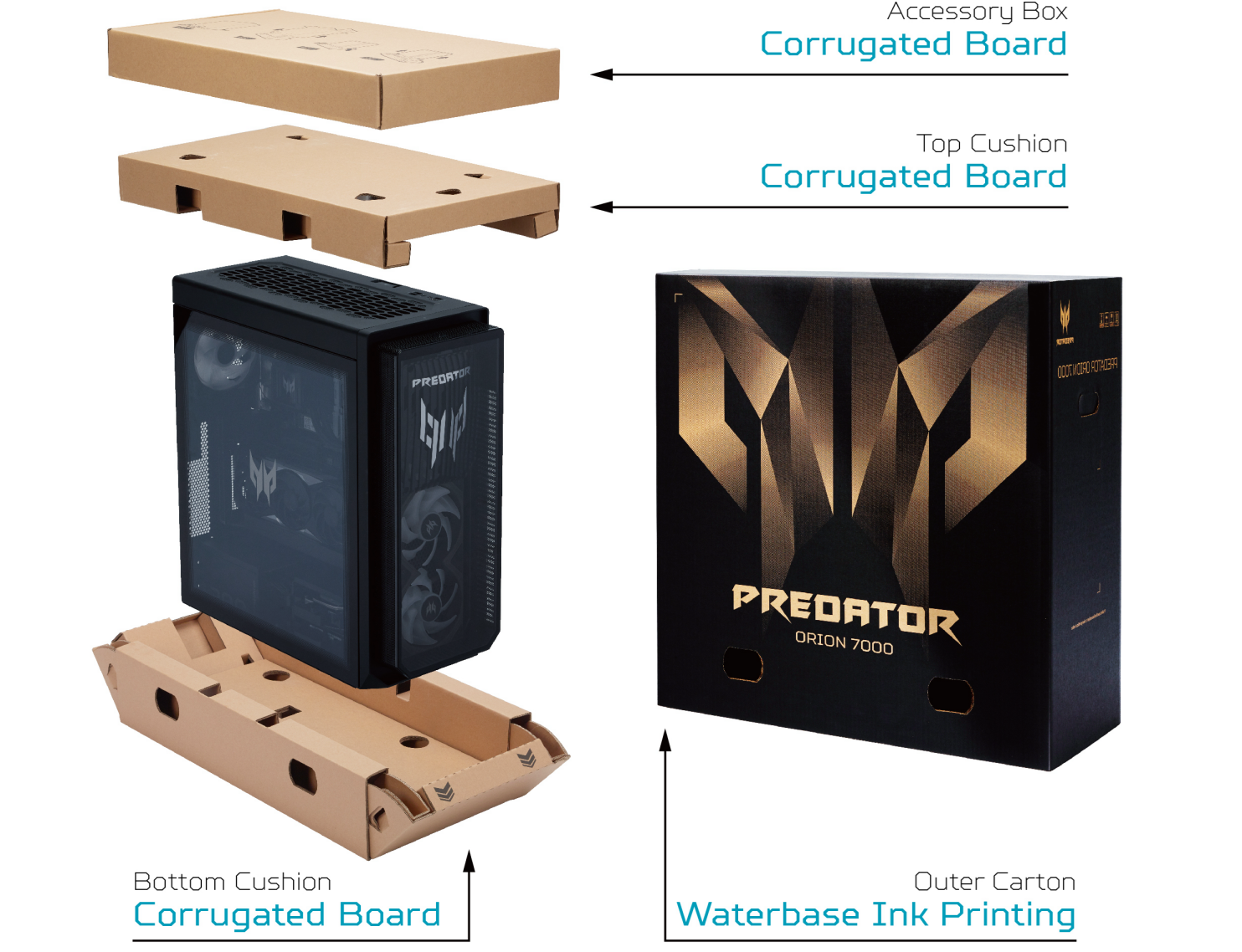
Predator Orion Gaming Desktop Computer
The packaging of Predator Orion 7000 focuses on environmental sustainability, utilizing recyclable corrugated cardboard and waterbased ink printing, hence completely replacing traditional foam plastics (such as EPS and EPE) and plastic materials to achieve 100% paper packaging. This design not only reduces resource consumption but also enhances user convenience and safety. The internal structure of the packaging is meticulously designed to support products up to 19 kg, ensuring protection during transport while optimizing the unboxing experience. The outer box features carrying holes for convenient customer handling; the inner base can be opened from both sides, allowing customers to easily remove the product, reducing unnecessary handling and risk of damage.
Green Packaging Policy

Acer continued to make use of environmentally friendly packaging for our notebook computers
Cardboard Boxes
Made from recycled paper
90%
Moulded Pulp
Made from recycled kraft paper
100%
Polyethylene foam(EPE)
Made from recycled low-density polyethylene (LDPE)
100%
Posters
Made from FSC certified paper
FSC
Printed Matter
Made from recycled paper
40%
Non-woven Fabrics
Made from recycled PET
100%
Aspire Vero notebook green packaging design won Red Dot Design Award for Packaging Design
In 2022, Acer Aspire Vero packaging design maintains the concept of reducing and reusing plastic, replacing heat shrinkable film and plastic bags with recycled paper, and improving the functionality of reusable packaging materials. For example, the package box can be easily assembled and repurposed as a storage box, and the internal partition can be turned into a notebook stand with just a few simple steps. Furthermore, the paper tray and cushion can be used as nursery pot, prolonging the lifespan of the package material that should have been discarded after unboxing, and echoing Acer’s concept of circular design.
The package box for this year uses 90% recycled pulp where 100% recycled pulp is used to make molded pulp cushion materials. The notebook sleeve and the protective sheet between the keyboard and the screen are all made of 100% recycled PET material.
.jpg)
Product Distribution
Acer continues to promote the reduction of carbon emissions and plastics in logistics, transportation, and packaging operations. We are committed to enhancing transportation efficiency by changing the shipping mode and improving supply chain management, which includes reducing the volume and weight of product packaging. Additionally, we adopt new energy sources to decrease energy consumption during transportation, thereby further reducing carbon emissions and lowering transportation Product Distribution costs. Although logistics transportation only accounts for about 4% of the total carbon emissions in the product life cycle, we do not cease our efforts to seek new energy sources for carbon reduction. We value and are eager to explore opportunities to decrease carbon emissions.
Reduction of carbon emissions through adoption of new energy sources
Acer primarily transports its products to customers by sea, either directly or indirectly. Since 2022, we have piloted the use of Sustainable Marine Fuel (SMF). In 2023, we enhanced our partnership with logistics providers, KUEHNE+NAGEL and Expeditors, to significantly decrease 481 tones of carbon emissions from using SMF by 12 times compared to 2022, resulting in an almost 4% reduction in global maritime transportation emissions. Acer's logistics carbon reduction targets are in line with the greenhouse gas emission strategies of the International Maritime Organization (IMO). We aim to contribute 5-10% of the international maritime energy by 2030 by adopting zero or near-zero greenhouse gas emission technologies, fuels, or energy sources. This is one of the reasons that we are actively embracing SMF.
reduction in global maritime transportation emissions
4 %
Furthermore, starting in 2023, Acer began promoting the transportation of notebook computers using electric vehicles in Chongqing, with an initial focus on commercial models. By 2023, 52% of commercial notebook computers were already being delivered locally in Chongqing using electric vehicles. This successful case is expected to pave the way for future expansion to more cities, with the adoption of suitable electric vehicles.


Minimizing carbon emissions through logistics consolidation
Following the completion of notebook computer production in China, we closely collaborate with our logistics suppliers to continuously enhance the land transportation. We have successfully implemented logistics consolidation to transport 87% of the products to the port, resulting in a reduction of 779 truck trips. This has further decreased carbon emissions during the transportation process by 593 tons, surpassing the performance achieved in 2022. Not only has it cut transportation costs but it also fulfilled the objective of reducing carbon emissions.
Elimination of yellow packing tape
Commencing in 2022, we initiated a gradual elimination of yellow packing tape, starting with our monitor products. Following an evaluation of its effectiveness in 2023, we plan to extend this policy to our entire product lines by 2024. As a result, we will reduce our tape usage by over 10,000 kilometers annually, which is equivalent to a quarter of the Earth's circumference.
Moving forward, Acer will maintain its commitment to three key policies aimed at reducing carbon emissions and plastic waste in logistics, transportation, and packaging, first implemented in 2022.
Implementing new energy solutions for logistics and transportation
Enhancing order consolidation efficiency through order management control tower
Streamlining logistics packaging operations while prioritizing cargo safety
We choose reputable logistics service providers and adopt the constantly evolving and updated transportation technology in the industry for Acer's product transportation operations.